Address
304 North Cardinal St.
Dorchester Center, MA 02124
Work Hours
Monday to Friday: 7AM - 7PM
Weekend: 10AM - 5PM

Address
304 North Cardinal St.
Dorchester Center, MA 02124
Work Hours
Monday to Friday: 7AM - 7PM
Weekend: 10AM - 5PM
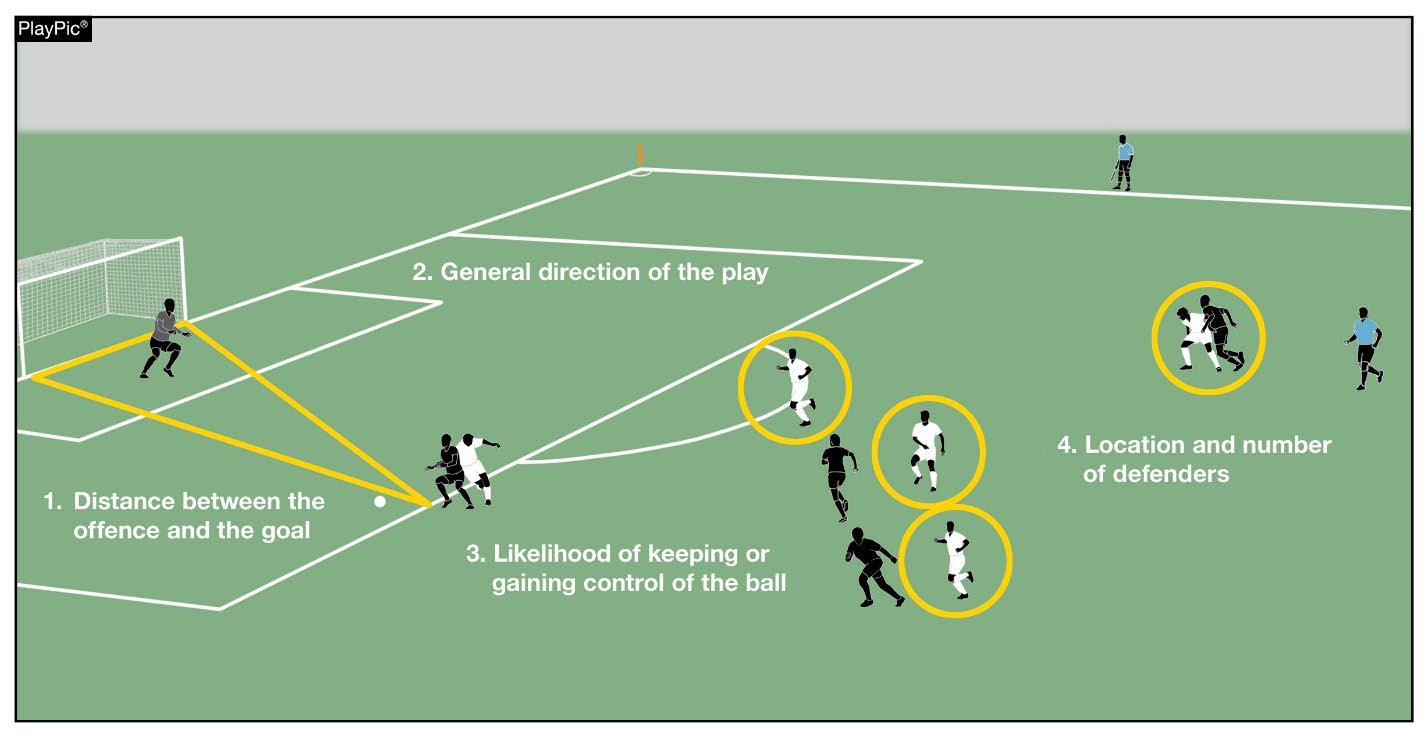
NFHS has released a clear interpretation of DOGSO considerations.
 Byadmin

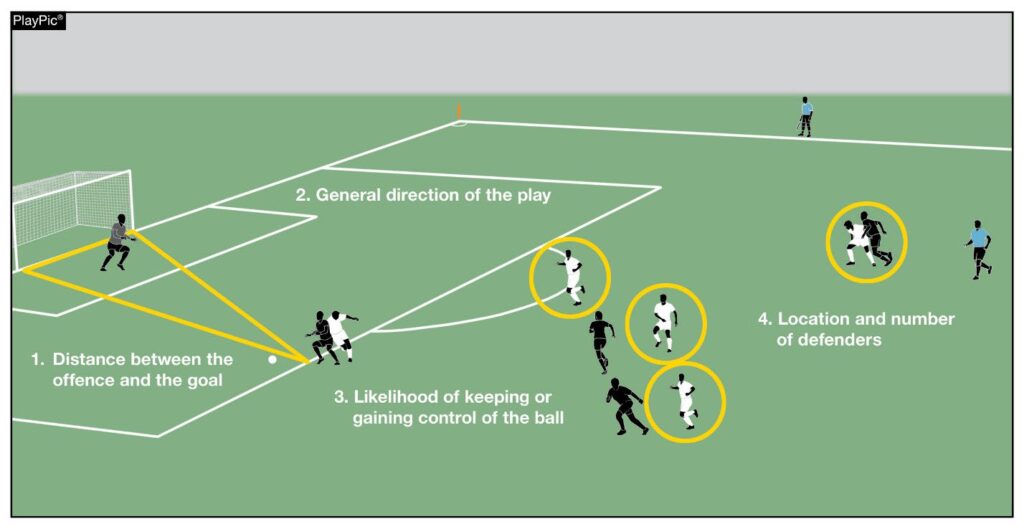
When determining if an offense denies an obvious goal-scoring opportunity, the following shall be considered, and all four must be present to determine if an attack is an obvious goal-scoring opportunity:
1. distance between the offense and the goal (the closer to the goal, the more likely the attackers have an obvious chance to score);
2. general direction of the play (the attacking players must be generally headed toward the goal);
3. likelihood of keeping or gaining control of the ball (the attacker or a teammate must have or been able to control the ball in order to score);
4. location and number of defenders (not counting the offender, if there is more than one defender – including the goalkeeper – between the attacker and the goal who can challenge the attacker or attempt a save, then this criterion is not met).
Offenses which deny an obvious goal-scoring opportunity are not limited to those punishable by a direct free kick or penalty kick. Offenses may include indirect free kick fouls as well.
If any element is missing, the player cannot be ejected for denying an obvious goal-scoring opportunity. However, this may indicate an attack is promising and additional factors should be considered.
A player shall be ejected (red card) for committing an offense that denies the opposing team a goal or an obvious goal-scoring opportunity (DOGSO), resulting in a free kick, and the goal is not scored, by:
1. deliberately handling the ball (except a goalkeeper within their penalty area);
2. committing a direct or indirect free kick offense outside their penalty area;
3. committing an indirect free kick offense inside their penalty area;
4. committing a direct free kick offense inside their penalty area, while not attempting to play the ball (e.g., holding, pulling, pushing, no possibility to play the ball, etc.).
SITUATION: Team B’s goalkeeper, B5, is caught out of position on a counterattack by Team A. Dribbling the ball, attacker A1 is moving toward the goal with only defender B12 between A1 and the goal. With an obvious goal-scoring opportunity, A1 shoots the ball toward the goal. B12 deliberately uses a hand/arm to stop the ball from entering the goal. B12’s handball foul occurred (a) outside Team B’s penalty area; (b) inside Team B’s penalty area. RULING: In (a) and (b), B12 is ejected for denying a goal by deliberately handling the ball. Team A is awarded a direct free kick from the spot of the foul in (a) and a penalty kick in (b). [12-8-3]
SITUATION: With an obvious opportunity to score, attacker A3 is carelessly fouled outside Team B’s penalty area by defender B8. The referee stops play and awards a direct free kick to Team A from the spot of the foul. B8 is ejected and shown the red card for denying an obvious goal-scoring opportunity. RULING: Correct procedure. [12-8-1]
SITUATION: Attacker A7 is dribbling the ball inside Team B’s penalty area and is moving toward the goal with an obvious goal-scoring opportunity. The referee awards a penalty kick after defender B2 (a) pulls A7’s jersey so Team B’s goalkeeper can collect the ball; (b) carelessly pushes A7 off the ball; (c) carelessly trips A7 while attempting to play the ball. RULING: In (a) and (b), B2 is ejected for denying an obvious goal-scoring opportunity. Although a penalty kick was awarded, B2 is still ejected because there was not an attempt to play the ball. In (c), B2 is cautioned because there was an attempt to play the ball. [12-8-2]
SITUATION: Inside the penalty area, attacker A2 has an obvious goal-scoring opportunity with only defender B1 and Team B’s goalkeeper between A2 and the goal. A2 takes a shot on goal, and the ball contacts B1’s hand/arm while (a) B1 was holding their hand/arm away from their body, extended from their side, and stationary when the ball made contact; (b) B1 was turning away from the shot, moving their hand/arm away from the ball with their hand positioned behind their back and their arm held closely to their body. RULING: In (a) the referee awards a penalty kick to Team A and ejects B1 for denying an obvious goal-scoring opportunity. B1’s arm placement has made their body unnaturally bigger. The position of B1’s arm is not a consequence of, or justified by, their body movement in that situation. By holding their hand/arm in that position, B1 risks having the ball make contact and being penalized. In (b), the contact is judged as non-deliberate, and the referee allows play to continue. [12-2-2]